
-
17 juillet 2026
Date de l'événement :
-
8 novembre 2026
Fin de l'événement :
À quoi s’attendre en 2026
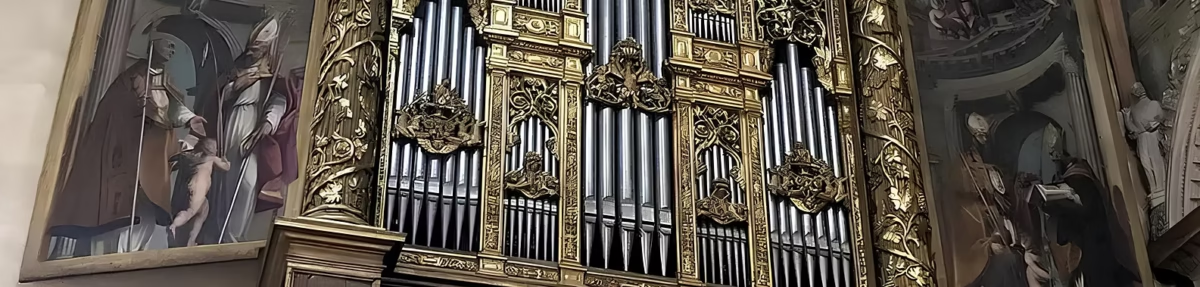
Festival Organi Storici di Verona 2026 is an international organ concert series dedicated to the historic organs of Verona and the surrounding province. Rather than being concentrated in one festival hall, the event creates a musical journey through churches, cathedrals, abbeys and historic religious buildings across the Verona area.
The 2026 edition features 30 concerts distributed throughout the province, bringing together established performers and emerging young musicians. The organisers describe the festival as an opportunity to rediscover historic instruments, monuments and places through live performance.
The programme focuses particularly on the historic organ-building tradition of the Verona region. The instruments represented in the 2026 programme range from eighteenth-century organs to twentieth- and twenty-first-century restorations and instruments incorporating later interventions.
Profitez de votre événement sans stress avec Italy Travelo
Que vous voyagez pour un festival mondialement connu, un concert en direct, une célébration culturelle ou un événement professionnel, Italy Travelo vous aide à simplifier chaque étape de votre voyage. Notre équipe propose une assistance personnalisée aux voyages, vous permettant de vous concentrer sur la création de souvenirs durables.
The festival also demonstrates the variety of sounds possible from these instruments. Some performances are solo organ recitals, while others combine organ with trumpet, soprano, saxophone, choirs, vocal ensembles or baroque brass instruments.
A notable feature of the 2026 edition is its support for younger performers. Thirteen of the 30 concerts are entrusted to young soloists, while another 15 concerts feature artists with established reputations.
All scheduled concerts are listed as free admission, making the festival an accessible way to discover historic music, architecture and organ heritage across the Verona province.
Dates des événements
Festival Organi Storici di Verona 2026 runs from 17 July through 8 November 2026.
The programme is spread over several months rather than concentrated into one weekend. Concerts take place in different municipalities and districts, allowing the festival to cover Verona city, Lake Garda, Valpolicella, Lessinia, Verona Est and the western and southern areas of the province.
This extended schedule makes the festival particularly suitable for visitors who want to combine a concert with sightseeing in Verona, Lake Garda or the surrounding towns.
The final concert of the published programme takes place at the Chiesa Parrocchiale di Santa Maria in Stelle, featuring organist Daniele Ferretti and soprano Barbora Kršiaková.
Vous visitez cet événement ? Ne manquez pas ces activités et expériences locales étonnantes pendant votre séjour.
Lieu et site du festival
Festival Organi Storici di Verona does not have a single festival site. Its defining characteristic is the use of historic churches and religious buildings throughout the province of Verona.
The festival’s administrative address is:
- Festival Organi Storici di Verona
- c/o Associazione Musicale di Vigasio
- Via Amerigo Vespucci, 2
- 37068 Vigasio, Verona, Italy
The 2026 concert programme includes venues such as the Duomo of Desenzano del Garda, the parish church of Malcesine, churches in Caprino Veronese, Peschiera del Garda, Parona di Valpolicella, Fumane, Erbezzo and Boscochiesanuova, as well as numerous churches and cathedrals in Verona itself and the wider province.
Historic organs are an integral part of each venue. The programme identifies the individual instrument used for every concert, including instruments by Serassi, Sona, Cavazzani, Aletti, Bonatti, Callido, Farinati, Mascioni and other Italian organ builders.
Programmation complète
The 2026 programme includes 30 concerts and a wide selection of organists, vocalists, instrumentalists, choirs and ensembles.
Featured performers and groups include:
- Luca Gorla
- Stanislav Šurin
- Plamena Angelova
- Roberto Mucci
- Alberto Frugoni
- Roberto Bonetto
- Ensemble Organa et Bucinae
- Emmanuel Arakélian
- Cinzia Zanon
- Coro Gioventù in Cantata
- Paolo Bougeat
- Matteo Varagnolo
- Holger Gehring
- Markus Czieharz
- Giulio Bonetto
- Jacopo Gressini
- Ensemble di trombe barocche Scintillanti Armonie
- Giovanni Calò
- Nadal Roig y Serralta
- Ensemble vocale D’altro Canto
- Kohe Takeoka
- Coro A.LI.VE
- Ensemble vocale Bequadro
- Luca Maresca
- Stefania Mettadelli
- Gregorio Vedovato
- Tiberio Aganetti
- Olimpio Medori
- Miriam Urbani
- Carlo Benatti
- Paolo Buro
- Andrzej Chorosinskj
- Fabio Frigato
- Giulio Mercati
- Franz Hauk
- Przemysław Kapituła
- Sandro Carnelos
- Elena Cipriani
The lineup also includes several local and regional choirs and ensembles, reinforcing the festival’s connection with the musical communities of Verona and surrounding municipalities.
Têtes d’affiche et artistes invités
Festival Organi Storici di Verona does not use a conventional headline format. Each concert places the performer and the historic instrument at the centre of the programme.
Among the internationally recognised names appearing in the 2026 schedule is Polish organist Stanislav Šurin, who performs at Malcesine with soprano Plamena Angelova. The programme also features German organist Holger Gehring at San Nicolò all’Arena in Verona.
Andrzej Chorosinskj appears at the Abbey of Isola della Scala, while Franz Hauk performs at the parish church of Cadidavid. Przemysław Kapituła is featured at Sommacampagna, and Giulio Mercati performs at Nogarole Rocca.
Young musicians are another important component. The organisers state that 13 of the 30 concerts are entrusted to young soloists as part of the festival’s support for emerging concert performers.
Scènes et zones de spectacle
There are no conventional festival stages, outdoor main stages or VIP areas. Instead, every historic church effectively becomes an individual concert setting.
The 2026 performance areas are organised geographically:
- Verona – Lake Garda
- Valpolicella
- Verona North – Lessinia
- City of Verona
- Verona East
- Verona West and Verona South
The City of Verona section includes important historic venues such as San Nicolò all’Arena, Santa Maria in Organo, San Tomaso Cantuariense, San Pietro in Monastero, the Cathedral and San Bernardino.
This structure allows visitors to experience both the music and the architecture associated with each historic instrument.
Programme étape par étape
Because the festival is distributed across dozens of churches and towns, its programme is best understood as a venue-by-venue concert itinerary.
Verona – Lake Garda
The programme includes concerts at Desenzano del Garda, Malcesine, Pesina di Caprino Veronese and Peschiera del Garda. Performances include solo organ recitals as well as organ with soprano and organ with brass ensemble.
Valpolicella
The Valpolicella programme includes performances at Parona di Valpolicella, Sant’Ambrogio di Valpolicella and Fumane, combining organ recitals with choral music.
Verona North – Lessinia
Erbezzo and Boscochiesanuova host organ and organ-with-trumpet performances, while Santa Maria in Stelle provides the setting for the festival’s concluding concert.
City of Verona
The city programme includes San Nicolò all’Arena, Santa Maria in Organo, San Tomaso Cantuariense, San Pietro in Monastero, the Cathedral and San Bernardino. Concert formats range from solo organ to vocal ensembles and baroque trumpet ensembles.
Verona East
Soave and Caldierino feature organ performances, including a concert combining organ and soprano at Caldierino.
Verona West and South
The programme includes Palazzolo di Sona, Isola della Scala, Concamarise, Bovolone, Sommacampagna, Cadidavid, Valeggio sul Mincio and Nogarole Rocca.
Temps de set
Concert times vary according to the venue and programme.
The published 2026 schedule includes performances beginning in the late afternoon as well as evening concerts. Examples include a 5:00 PM concert at San Nicolò all’Arena, a 4:30 PM performance at San Tomaso Cantuariense and evening performances beginning at 8:30 PM or 9:00 PM.
Visitors should check the individual concert listing before travelling because there is no single daily festival opening time.
The published programme also shows that some concerts can be subject to changes or cancellations. For example, the Cologna Veneta concert was cancelled after a storm made the historic organ temporarily unusable.
Types de billets
All concerts in the 2026 programme are listed as free admission.
There is therefore no standard paid festival pass, general admission ticket or multi-day ticket. Visitors can attend individual concerts without purchasing a festival-wide ticket.
Because seating takes place inside churches and other historic buildings, availability can depend on venue capacity. Visitors should arrive early, especially for concerts featuring well-known performers or ensembles.
The official programme should be checked for any special admission instructions associated with an individual concert.
Options VIP et premium
Festival Organi Storici di Verona does not advertise VIP tickets, premium seating packages, backstage passes or hospitality upgrades for the 2026 programme.
The festival is structured around free public concerts in historic religious and cultural locations. Its emphasis is on access to music, heritage and historic instruments rather than premium festival hospitality.
There is consequently no published VIP ticket price or premium package for the 2026 edition.
Règles de l’épreuve
As the concerts take place inside churches and historic buildings, visitors should observe normal concert etiquette as well as the rules of the individual religious venue.
Important guidelines include:
- Arrive before the concert begins.
- Gardez les téléphones portables silencieux pendant les représentations.
- Avoid unnecessary movement during the music.
- Follow instructions from venue staff and organisers.
- Respect the religious character of churches used as concert venues.
- Follow any photography or recording restrictions.
- Keep entrances and aisles clear.
- Respect other audience members.
The festival programme can also be affected by circumstances involving the historic instruments themselves. Weather, technical conditions and restoration requirements may occasionally result in programme changes or cancellations, as demonstrated by the published cancellation of the Cologna Veneta concert.
Comment y arriver
Because the festival takes place throughout the province, travel arrangements depend on the individual concert.
For performances in central Verona, visitors can use the city’s historic centre as a base and travel to the relevant church by walking, bus or taxi.
For concerts outside Verona, a private vehicle can be useful because some participating towns and rural locations have limited direct public transport connections, particularly for evening performances.
Visitors travelling specifically for the festival should check the exact church and municipality shown in the official programme before planning their route.
Transports en commun et stationnement
Public transport is most convenient for concerts within Verona itself. The city has local bus connections linking the railway station with the historic centre and surrounding districts.
Verona Porta Nuova is the principal railway station and provides a useful arrival point for visitors travelling from other Italian cities.
For concerts in places such as Malcesine, Desenzano del Garda, Peschiera del Garda, Soave, Isola della Scala, Bovolone, Valeggio sul Mincio and smaller municipalities, visitors should check local transport connections individually.
Parking conditions vary by church and municipality. For evening concerts outside central Verona, arriving early is advisable because small town-centre parking areas can become busy.
Zones d’hébergement
Visitors attending several concerts can base themselves in Verona and make individual excursions to surrounding municipalities.
The historic centre is convenient for concerts in central Verona and provides access to restaurants, hotels and major cultural attractions.
The area around Verona Porta Nuova is useful for visitors arriving by train and provides a practical transport base.
For visitors focusing on the Lake Garda section of the festival, accommodation around Peschiera del Garda, Desenzano del Garda or Malcesine can reduce travel time to concerts in that area.
Valpolicella is another option for visitors interested in combining festival concerts with wine tourism and countryside stays.
Nourriture et boissons
Food and drink are not central components of Festival Organi Storici di Verona. The main attraction is the combination of organ music, historic instruments and architectural heritage.
However, the festival provides an opportunity to explore local food traditions in the towns hosting individual concerts.
Visitors travelling through Verona and the surrounding province can encounter regional specialties such as risotto all’Amarone, bigoli, gnocchi, pearà and traditional Veneto desserts.
Valpolicella concerts can also be combined with the area’s wine culture, while Lake Garda venues provide access to restaurants specialising in local lake, Veneto and Italian cuisine.
Because many concerts begin in the evening, visitors should consider eating before or after the performance, particularly in smaller towns where restaurant opening hours may vary.
Accessibilité
Accessibility varies substantially because the festival uses historic churches and religious buildings rather than one modern concert venue.
Historic entrances can include steps, narrow passages or uneven surfaces, and not every church will necessarily provide the same level of accessible facilities.
Visitors with specific mobility requirements should contact the organisers before attending a particular concert to confirm access arrangements for the relevant church.
The festival’s contact information lists the official email address as info@organistoriciverona.it and provides a telephone and WhatsApp contact for enquiries.
Meilleurs jours à assister
There is no single best concert day because the programme changes performer, instrument and venue for every appointment.
Visitors interested in historic organs should look for concerts featuring particularly significant instruments, such as the 1716 Bonatti organ at San Tomaso Cantuariense or the historic Sona, Callido, Farinati and Mascioni instruments listed throughout the programme.
Those interested in vocal music can choose concerts featuring soprano performances or choirs, while listeners interested in instrumental combinations can select programmes involving trumpet, saxophone, baroque brass or organ duos.
For visitors interested in Verona itself, concerts at the Cathedral, San Nicolò all’Arena, Santa Maria in Organo, San Pietro in Monastero and San Bernardino provide opportunities to combine historic architecture with the festival programme.
Faits marquants de l’année précédente
The festival has been running for 18 years, according to the 2026 organisers, and has developed into a major regional programme dedicated to historic organs and the organ-building heritage of Verona.
The previous programme demonstrated the festival’s geographical reach, with concerts in Verona, Lake Garda, Valpolicella, Lessinia and municipalities across the province.
The 2025 programme included international and Italian performers such as Maria Perucka, Roman Perucki, Nicola Benetti, Gabriele Giacomelli, Walter D’Arcangelo, Friedhelm Flamme, Andrzej Chorosinski, Luca Benedicti, Stefano Molardi, Luca Scandali, Sebastian Heindl and Giulio Mercati.
The 2025 edition also continued the festival’s tradition of combining organ with other instruments and voices, including violin, soprano, oboe, bassoon, choir and vocal ensembles.
The continuing restoration and preservation of historic organs is another important aspect of the festival. The organisers describe the event as part of a broader effort to ensure that these instruments remain active parts of the cultural landscape rather than simply historic objects.
Billets officiels
Festival Organi Storici di Verona 2026 concerts are officially listed as free admission. There is no standard festival ticket price to convert into USD and no published VIP ticket structure.
Visitors should consult the official programme before attending because individual concerts can be affected by changes, technical issues or other circumstances.
The official website provides the complete 2026 calendar, concert locations, performers and historic organs used for each performance.
Site officiel : organistoriciverona.it
Contact officiel : info@organistoriciverona.it
Localisation
FAQ
What is the primary mission of the festival throughout the Verona province?
The event is dedicated to safeguarding and celebrating the rich acoustic heritage of historic regional pipe organs. It brings antique instruments back to active musical life within sacred provincial spaces.
Where do the scheduled classical music recitals and concerts take place?
Performances are hosted across an extensive network of historic parish churches, rural sanctuaries, and monumental urban abbeys. These venues span both central Verona and the wider surrounding provincial territory.
How can music enthusiasts secure admission to the public concert series?
All scheduled performances throughout the entire festival calendar are offered entirely free of charge to the public. Attendees can simply arrive at the participating historic venues without needing advance tickets or reservations.
What musical repertoires are typically featured during the performance schedule?
Concerts showcase exquisite Baroque counterpoint, Renaissance polyphony, and specialized early sacred compositions carefully matched to historical instruments. Programs are designed to highlight the unique timbral qualities of each antique organ.
Who manages the artistic direction and administrative coordination of the event?
Artistic direction is led by Roberto Bonetto in close collaboration with cultural bodies like Frau Musika and the Società Amici della Musica. Together, they coordinate performer rosters and institutional partnerships across the region.

Laisser un commentaire