



À quoi s’attendre en 2027
Cavalcata dell’Assunta is Fermo’s major historical and religious reenactment, centred on the Palio dell’Assunta and the city’s ten Contrade. The festival recreates medieval and Renaissance traditions through costumed processions, horse racing, ceremonies, flag-waving, drumming, competitions and traditional food experiences.
The event has roots extending back to the Middle Ages and is described by its organisers as Italy’s oldest historical reenactment. The modern festival connects Fermo’s historic districts and outer Contrade with a programme that builds towards the Palio and its accompanying historical procession.
For 2027, the programme and individual event details will be announced by the organisers. Visitors can expect the traditional combination of historical pageantry, Contrade competitions, medieval entertainment, religious ceremonies and the Palio horse race.
Profitez de votre événement sans stress avec Italy Travelo
Que vous voyagez pour un festival mondialement connu, un concert en direct, une célébration culturelle ou un événement professionnel, Italy Travelo vous aide à simplifier chaque étape de votre voyage. Notre équipe propose une assistance personnalisée aux voyages, vous permettant de vous concentrer sur la création de souvenirs durables.
Dates des événements
The 2027 edition is expected in August 2027, with the exact dates and detailed programme still to be announced.
The main celebrations traditionally build towards the Feast of the Assumption, with the Palio and major historical events forming the central part of the festival. The organisers describe the Cavalcata as an annual event in Fermo connected with the city’s Assumption celebrations.
Visitors should check the official festival programme before planning individual performances, ceremonies or ticketed seating.
Vous visitez cet événement ? Ne manquez pas ces activités et expériences locales étonnantes pendant votre séjour.
Lieux et lieux de festival
The festival takes place throughout the historic centre of Fermo and at several important locations connected with the city’s Contrade and traditions.
- Piazza del Popolo: The central gathering place for ceremonies, entertainment, Contrade events, food activities and major festival presentations.
- Girfalco: A historic elevated area beside the Cathedral used for Contrade competitions and traditional activities.
- Fermo Cathedral: The religious centre for important ceremonies associated with the Cavalcata.
- Church of Santa Lucia: Traditionally associated with the beginning of the historical procession.
- Viale Vittorio Veneto: Part of the route used for the Palio horse race.
- Viale XX Settembre: Another important section of the race route and historical procession.
- Castello di Torre di Palme: A location used for selected historical presentations and celebrations.
Programme culturel complet
The 2027 programme will be announced by the organisers, but the established festival format includes a sequence of cultural, historical, sporting and religious activities.
The latest official programme included:
- Children’s Palio and educational activities
- Arrival and presentation of the Palio banner
- Gallo d’Oro drumming competition
- Bandiere al Vento flag-waving competition
- Contrade Hostarie with traditional dishes
- Tiro al Canapo tug-of-war
- Tiro per l’Astore archery competition
- Flag-wavers and musicians performances
- Presentation of Contrade ladies
- Night-time historical events
- Assignment of horses to the Contrade
- Procession historique
- Religious liturgy
- Blessing of jockeys and horses
- Pontifical Mass
- Historical procession to the racecourse
- Palio dell’Assunta horse race
- Victory celebrations and prize activities
Traditions et performances mises en avant
The festival’s identity comes from the traditions maintained by Fermo’s Contrade.
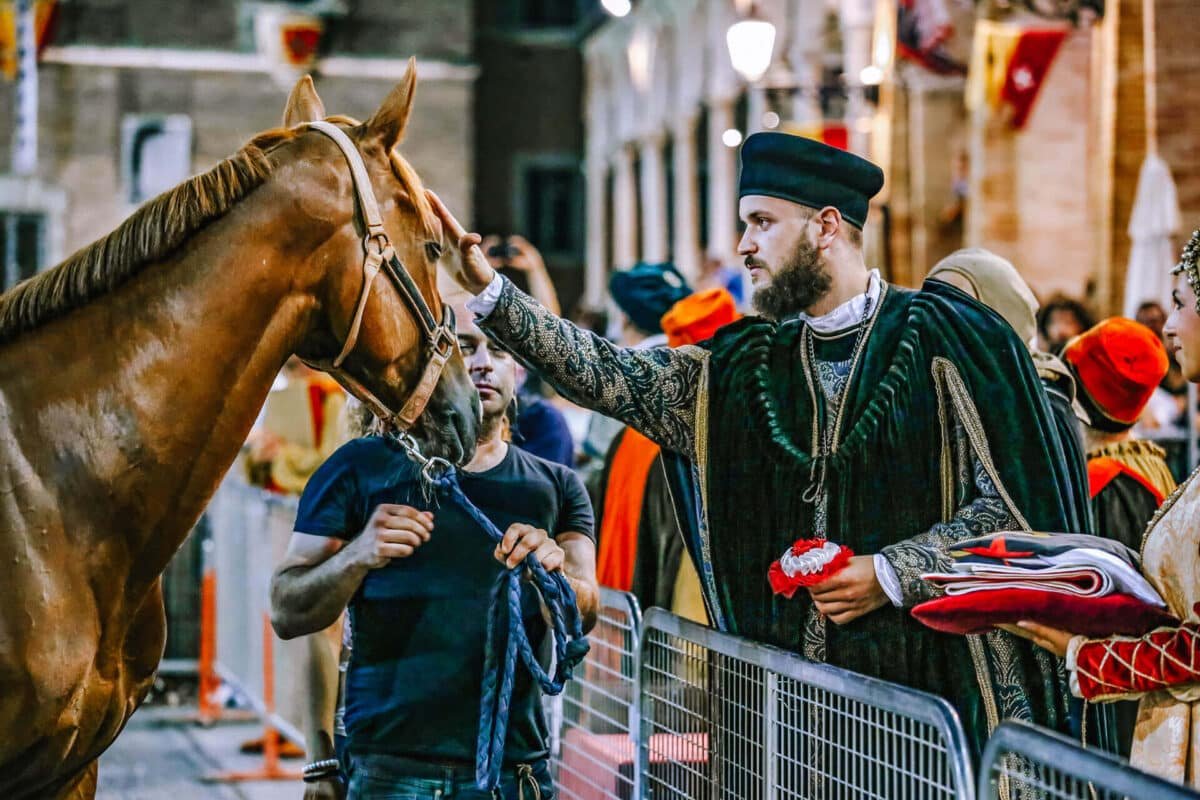
The historical group includes flag-wavers and musicians who perform throughout the festival and represent the colours, sounds and visual traditions of Fermo.
The principal performances and activities include:
- Flag-waving: Choreographed performances by the Contrade’s flag-wavers.
- Drumming: Contrade musicians provide the traditional rhythmic accompaniment.
- Historical costumes: Participants appear in costumes inspired by Fermo’s historical traditions.
- Horse racing: The Palio is the festival’s principal competitive event.
- Processions: Costumed groups move through the historic city centre.
- Contrade competitions: Several sporting and cultural competitions take place before the Palio.
Points forts historiques et patrimoniaux
The Cavalcata has a documented historical connection with Fermo’s Assumption celebrations dating back centuries. An important reference is an illuminated page from 1436 contained in the Missale De Firmonibus, which provides a visual representation of the Cavalcata.
The organisers also reference a document from 1182 concerning the commitment of surrounding castles to bring a Palio to Fermo for the Feast of the Assumption.
The city’s Contrade are central to this heritage. Six are identified as historic Contrade within the city walls, while four are outer Contrade located outside the historic centre.
Programme des événements et activités
The complete 2027 schedule has not yet been released. Based on the established programme, visitors can expect the festival to progress through several stages.
- Opening cultural activities: Children’s events, historical presentations and the arrival of the Palio.
- Contrade competitions: Drumming, flag-waving, tug-of-war and archery.
- Medieval atmosphere: Hostarie, traditional food and entertainment in Piazza del Popolo.
- Pre-Palio ceremonies: Horse allocation and other formal Contrade activities.
- Historical celebrations: Costumed processions and religious ceremonies.
- Palio day: Historical parade, race and subsequent victory celebrations.
Types de billets et options d’entrée
The 2027 ticket structure has not yet been announced. The main ticketed element in the latest published edition was seating for the Palio horse race.
Previous-edition published prices, converted to USD using approximately €1 = $1.17, were:
- Sector A: €20 equivalent to approximately $23.40
- Sector B full price: €12 equivalent to approximately $14.04
- Sector B reduced: €6 equivalent to approximately $7.02
- Enfants âgés de 0 à 5 ans : Gratuit
- Disabled spectators and eligible companions: Free under the published conditions
The reduced Sector B rate applied to eligible age groups and disabled companions under the published ticket conditions.
Visites guidées et expériences culturelles
The Cavalcata itself provides an immersive historical experience through the old streets, squares and heritage buildings of Fermo.
Visitors can also combine the festival with Fermo’s broader cultural attractions, including the Roman Cisterns, Palazzo dei Priori, the Globe Room, Teatro dell’Aquila, museums and historic churches.
The city’s tourism service also offers cultural itineraries and a tourist train experience departing from Piazza del Popolo, making it possible to explore the historic centre alongside the festival.
Cérémonies et célébrations spéciales
Ceremonial events form an important part of the Cavalcata.
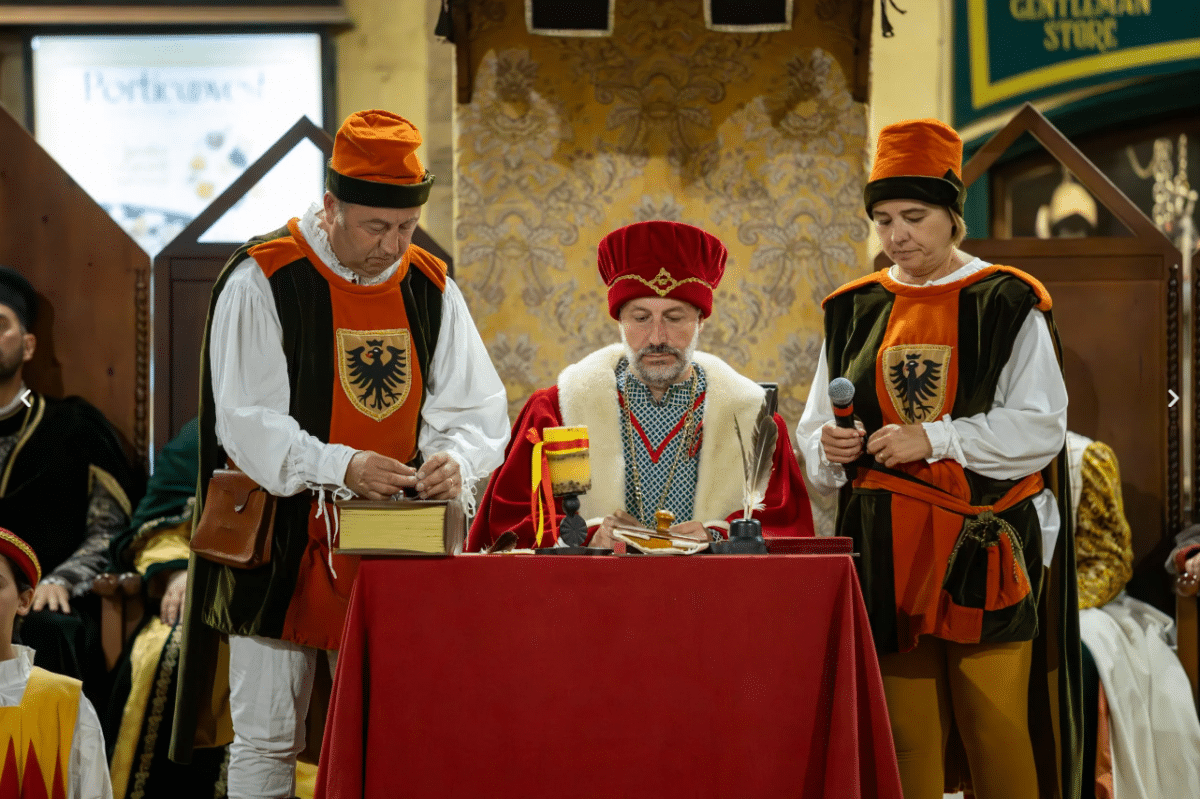
The traditional programme includes the investiture of the Priors, presentation of the Palio banner, assignment of horses to the Contrade, the historical procession, religious liturgy, blessing of the Palio, presentation of jackets to jockeys and the Pontifical Mass.
The historical procession is particularly significant because it recreates the ceremonial atmosphere associated with Fermo’s historic Cavalcata. The religious component reflects the festival’s connection with the Assumption of Mary and Fermo’s patronal traditions.
Règles du festival
Visitors should follow the rules of the festival organisers and individual venues.
For ticketed Palio areas, spectators must follow the seating and access conditions printed on their tickets. Children, reduced-rate visitors and disabled spectators are subject to the eligibility conditions specified by the organisers.
Because the festival includes horses, historical processions and large public gatherings, visitors should remain within designated spectator areas and follow instructions from event personnel.
Comment y arriver
Fermo is in the Marche region of central Italy and can be reached by road, rail and air.
- En voiture : The A14 motorway provides access through the Fermo-Porto San Giorgio exit.
- Par la route : The SS16 Adriatica connects the coastal area with the Fermo area.
- Par train : The Fermo-Porto San Giorgio railway station is the main rail connection for the city.
- Par avion : Raffaello Sanzio Airport near Falconara Marittima is the principal airport identified by the local tourism authority.
- From the railway station: A bus service connects Fermo-Porto San Giorgio station with Fermo.
Transports en commun et stationnement
Visitors arriving by train can continue from Fermo-Porto San Giorgio railway station by bus. The city also has local transport connections serving the historic centre and surrounding areas.
Fermo provides several parking options. Piazzale Carducci offers paid parking close to the centre, while the Maxiparking in Via Ficcadenti is a free option for longer stays and connects to the historic centre by escalator and pedestrian access.
During major festival events, visitors should allow extra time because the historic centre and procession routes can become busy.
Zones d’hébergement
Centre historique : The most convenient option for visitors who want to stay close to Piazza del Popolo, the Cathedral and the main festival atmosphere.
Fermo city: Offers hotels, B&Bs and other accommodation within practical reach of the festival locations.
Torre di Palme: A scenic option for visitors combining the Cavalcata with historic villages and the Adriatic coast.
Porto San Giorgio: A useful coastal base with access to Fermo by road and rail.
Fermo countryside: Agriturismi and rural accommodation provide an alternative for visitors interested in the surrounding Marche landscape. The local tourism authority lists hotels, B&Bs, campsites and farm stays among the accommodation choices in the area.
Cuisine et spécialités traditionnelles
Food is integrated into the festival through the Contrade Hostarie, where visitors can experience traditional dishes alongside medieval-themed entertainment. The official programme describes these as opportunities to taste traditional dishes in a historical festival setting.
The wider Fermo area is known for Marche cuisine, making the festival a useful opportunity to explore regional dishes at restaurants, food stalls and traditional establishments.
Visitors can combine the Hostarie experience with local specialties from the wider Fermano territory and the Marche region.
Accessibilité
The organisers’ published ticket information provides free admission for disabled persons and eligible companions in the designated Palio seating arrangements.
Accessibility can vary between individual historic locations because the festival uses churches, squares, elevated areas and historic streets.
Visitors with specific mobility requirements should contact the organisers before attending to confirm the most suitable entrance, seating area and route for the particular event.
Meilleures expériences culturelles
Procession historique : One of the defining experiences of the Cavalcata, combining costumes, ceremonial movement and Fermo’s historic streets.
Palio dell’Assunta: The central horse-racing tradition, involving the city’s ten Contrade. The race uses two heats followed by a final and takes place along an uphill route of approximately 850 metres.
Contrade competitions: The drumming, flag-waving, tug-of-war and archery competitions show different aspects of the local Contrade culture.
Piazza del Popolo: An important place to experience the atmosphere, food activities, entertainment and public celebrations.
Cathedral and religious ceremonies: These provide insight into the spiritual and historical dimension of the Cavalcata.
Faits marquants de l’année précédente
The previous edition featured a broad programme of events involving all ten Contrade, including children’s activities, the Palio presentation, drumming and flag-waving competitions, traditional food events, tug-of-war, archery and historical performances.
The programme culminated in the historical procession, religious ceremonies and the Palio horse race, followed by a victory celebration in Piazza del Popolo.
The edition also demonstrated the festival’s established use of Fermo’s historic centre, Girfalco, Cathedral area, Torre di Palme and race route as interconnected cultural spaces.
Billets officiels
Official 2027 ticket information has not yet been released.
The latest published ticket information shows that Palio seating can be purchased through the festival’s official ticket channels, including designated Fermo outlets and the online Live Ticket service. Previous published prices ranged from approximately $7.02 to $23.40, depending on seating and eligibility.
For 2027, visitors should use the official Cavalcata dell’Assunta website for the new programme, ticket availability, seating arrangements and purchasing instructions.
Site officiel : Cavalcata dell’Assunta, Via Mazzini 4, 63900 Fermo, Italy.
Téléphone : +39 0734 466714
Courriel : info@cavalcatadellassunta.it
Press: press@cavalcatadellassunta.it
Presidency: presidenza@cavalcatadellassunta.it
Vidéo
Localisation
FAQ
What is the primary historical significance of the Cavalcata dell'Assunta festival?
The festival represents the oldest documented historical reenactment and civic horse race across Italy, rooted in ancient traditions. Archival records verify that its foundational processional tributes date back uninterruptedly to the late twelfth century. It successfully preserves medieval municipal customs, religious devotion, and community identity to this modern day.
How are the competing neighborhoods or contrade structured during the event?
Fermo is divided into ten distinct contrade, comprising six historic center districts and four outer suburban territories. Each neighborhood operates under an elected leader known as a prior and maintains its own unique heraldic colors. These districts compete fiercely in games, pageantry, and athletic events throughout the multi-week celebration.
What activities take place during the grand historic procession?
Over a thousand participants clad in meticulous hand-sewn Renaissance costumes march through the ancient stone streets. Noble lords, ladies, musicians, heralds, and artisan guilds recreate the chronological hierarchy of the city's golden age. The procession moves from lower historical checkpoints up to the hilltop cathedral square in stunning visual splendor.
Can visitors experience traditional local food during the festival weeks?
Visitors can enjoy authentic regional culinary heritage through pop-up neighborhood taverns operating across the city squares. These taverns serve traditional Marche dishes, handmade pasta, local grilled meats, and regional wines in communal settings. Formal historic banquets also recreate multi-course Renaissance dining experiences complete with minstrel music.
What safety and regulatory measures govern the bareback horse race?
The climax bareback horse race held on the Girfalco hill is strictly regulated by comprehensive animal welfare protocols. Independent veterinary teams conduct thorough medical examinations on every participating horse before and after training sessions. Jockeys and track layouts also undergo rigorous safety checks to ensure a secure and fair competition.

Laisser un commentaire